Submitted by Yusraah Zakir, an STCC student and member of Phi Theta Kappa
Hello, my name is Yusraah Zakir and I am a biology major and a member of the Phi Theta Kappa Honor (PTK) Society at Springfield Technical Community College. The mission of PTK is to encourage and recognize students’ academic achievement and provide opportunities for leadership, service, and fellowship. Through my involvement in PTK, I have had the opportunity to organize and participate in our panel discussion on Environmental Sustainability as part of our Honors in Action project.
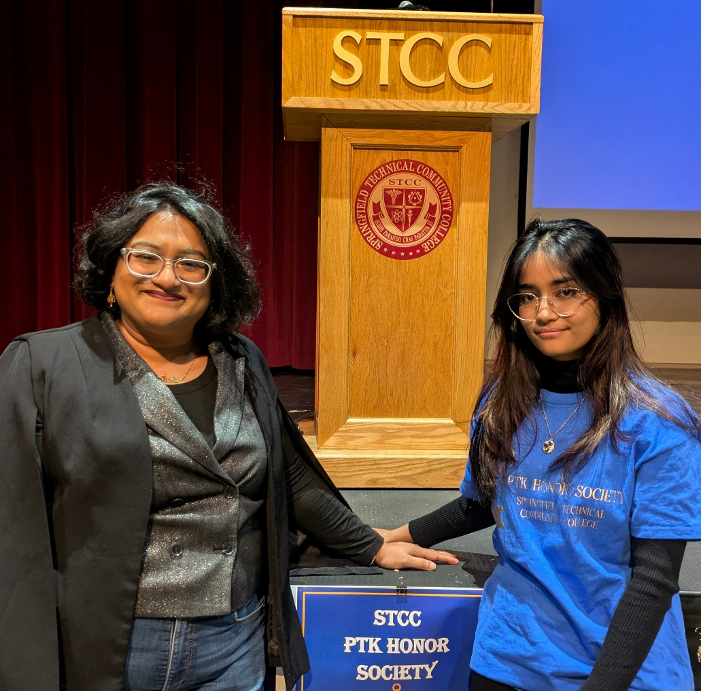
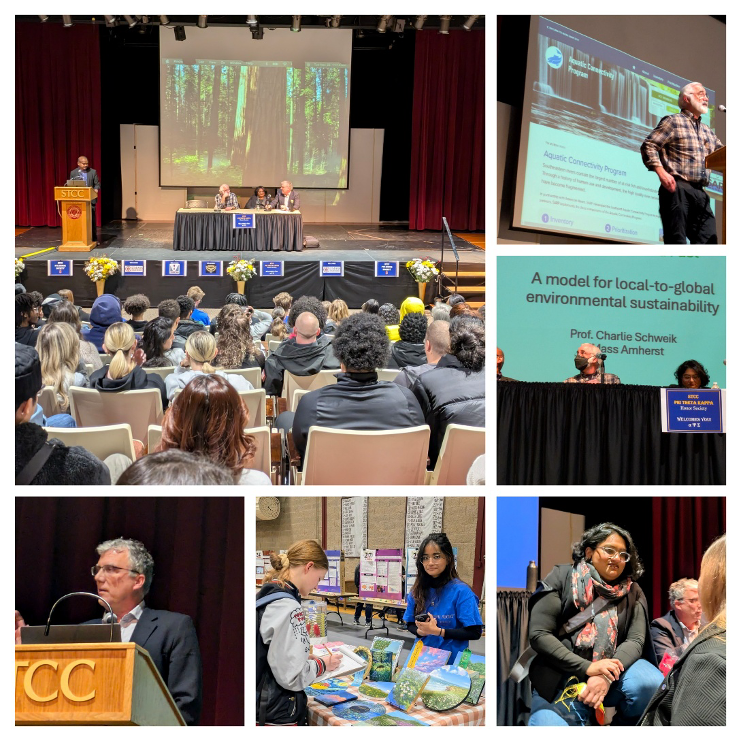
The focus of the panel was environmental sustainability, which emphasizes meeting current needs while preserving resources for future generations. I was pleasantly surprised with the strong turnout for the event which reflected how relevant this topic is to students and the broader community. The auditorium was filled, creating an atmosphere of shared curiosity and engagement. The panel featured UMass Amherst professors, namely, Dr. Scott Jackson spoke about Wildlife Conservation, Dr. Charles Schweik for Environmental Policy, Dr. Timothy Randhir about Water Sustainability and Dr. Trisha L. Andrew for Wearable Electronics. Their expertise provided real-world applications of sustainability concepts and reinforced the chapter’s research conclusions. What stood out to me most was how these disciplines overlapped, reinforcing that environmental sustainability requires collaboration across many fields.
Dr. Trisha L. Andrew’s presentation on wearable electronics and smart textiles left a particularly strong impression on me. As a biology major, Dr. Andrew’s discussion of the environmental and public health consequences of textile manufacturing was especially intriguing. She emphasized how traditional textile processing consumes enormous amounts of water and releases toxic chemical waste into surrounding communities. One point that stood out to me was her explanation that many textile plants continue polluting water sources because the fines they pay are simply treated as part of their operating costs. This reality highlights a serious environmental justice issue, as polluted water disproportionately affects nearby populations.
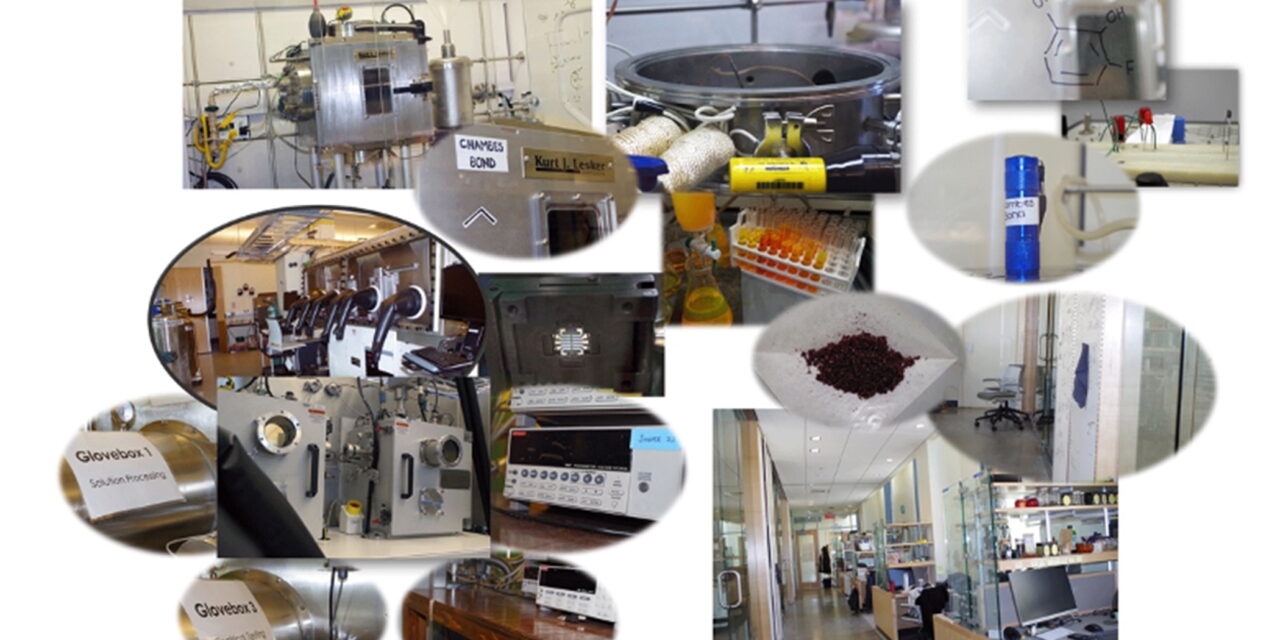
Dr. Andrew then introduced an alternative approach inspired by microelectronics manufacturing. Unlike traditional textile processing, silicon chip fabrication relies on dry, vapor-based chemical processes that produce little to no water pollution. She described how this realization led her to ask an important question: why can’t textiles be manufactured using similar methods? Her research answers this question using Chemical Vapor Deposition (CVD). By applying this technique to textiles, her research aims to reduce water pollution while also transforming fabrics into functional materials with applications in wearable electronics, sensing technologies, and energy harvesting. Below is a picture of her lab in UMass, Amherst.
After the panel, I had the opportunity to speak with Dr. Andrew and reflect further on her work. We discussed how shocking it is that something as everyday as clothing can contribute so heavily to water contamination and how innovative manufacturing techniques like CVD could offer more sustainable alternatives. As a biology major, this helped me better understand how chemistry, materials science, and biology intersect to address environmental and human health challenges by targeting environmental problems at their source rather than simply managing their consequences.
Overall, this panel discussion was eye opening and inspiring. It demonstrated that environmental sustainability is not limited to one field but requires interdisciplinary thinking and collaboration. Being part of this event reinforced my appreciation for PTK and for STCC as a place where students are encouraged to engage in complex, real world problems. I left the event with a deeper awareness of how science and innovation can drive meaningful change toward a more sustainable future.