(Submitted by STCC student Leah Kabue)
Hello, my name is Leah Kabue, and I am a Health Science major at Springfield Technical Community College. I love STCC because it has given me opportunities to pursue my dream of serving in the healthcare field. I enjoy participating in Phi Theta Kappa Honor Society activities as a provisional member, which has helped me become more involved on campus and in community service.
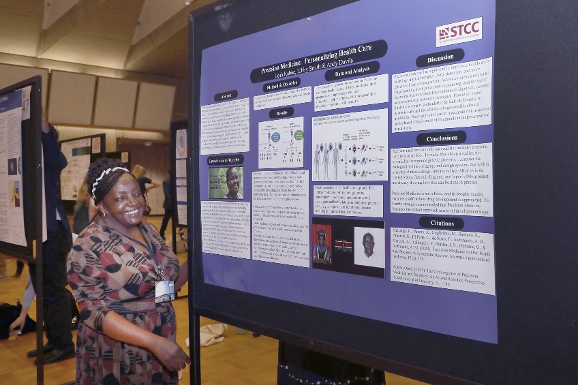
This spring semester, I had the wonderful opportunity to present my Human Anatomy and Physiology class research project on Precision Medicine at the UMass Undergraduate Research Conference. My goal in participating in this conference was to increase my knowledge of science and research. This conference, further, offered me a rare opportunity to benefit from an academic exchange. For example, it enabled me to visit the esteemed University of Massachusetts for the first time and expand my academic horizon.
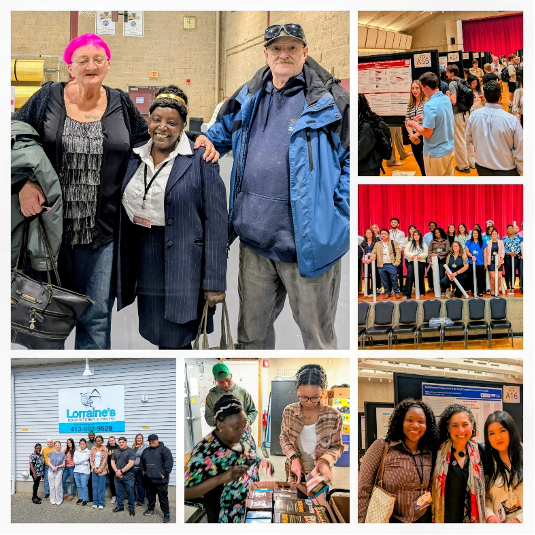
Brilliant ideas are usually shared at such conferences, and it was my desire to be part of this great exchange. I regarded this as a unique opportunity that would offer me the chance to share my research alongside that of my fellow students in real time. As I was initially intimidated by the challenge, my intention was to be emboldened and develop stamina in my academic pursuits.
The UMass Undergraduate Research Conference gave me the opportunity to present my research in a professional academic setting and share my ideas with students, faculty, and scholars. It was a powerful experience that expanded my confidence, deepened my interest in research, and helped me see my work as part of a larger scientific conversation.
An example of this realization was the moment, such as the one captured in the picture above, where I was able to answer questions pertaining to my research, such as: “Why did you choose to research Precision Medicine?” and “Is it any different from individualized treatment?” I would go on to explain that Precision Medicine does not rely simply on doctors’ observations and common laboratory tests but relies heavily on input from nuclear medicine and advanced scientific tools.
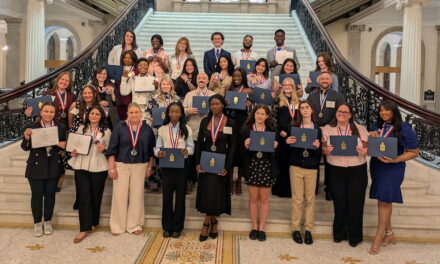
Another example of this realization was the moment when we were invited to assemble as students whose work had been publicly viewed and valued as an academic contribution, adding to past and current knowledge and paving the way for future research and expansion of this knowledge.
In conclusion, my experience can be summarized as follows: L.E.A.H.
“L” denotes the learning experience this conference offered. I sharpened basic skills such as computing research ideas and narrowing them down to one that expressed my precise sentiments.
“E” denotes enlightenment. I was enlightened in the process of my research. In addition, I was enlightened by the research of the large population of students who shared their research projects.
“A” denotes the academic experience this conference was, enhancing my pursuit of excellent scholarship.
“H” stands for honor. Having my work among those publicly viewed and valued by other scholars was an awesome privilege.
Presenting at the UMass Undergraduate Research Conference was a powerful and memorable experience for me. It strengthened my interest in Health Science, research, and Precision Medicine, and it helped me see myself as part of a larger academic community where student voices and student research truly matter.
In addition to my academic experience, one of my other memorable activities with Phi Theta Kappa was volunteering at Lorraine’s Soup Kitchen & Pantry, an organization that addresses food security in this region. This experience reminded me that learning, service, and leadership are all connected, and that as students we can make meaningful contributions both inside and outside the classroom.