Submitted by Emelia Mensah, vice president of the PTK Chapter at STCC.
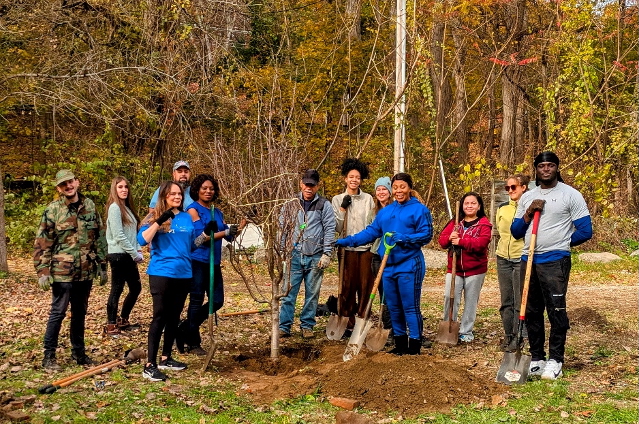
At exactly 10 a.m., members of STCC’s Phi Theta Kappa Honor Society arrived at La Finca Farms in Holyoke for a one-of-a-kind volunteer experience, one that went far beyond simply planting trees. It was an opportunity to help a city breathe again. As the society’s vice president, I had the honor of guiding our team through this impactful community service project. The work aligned with our Honors in Action project, which focuses on environmental sustainability, making this tree-planting initiative a meaningful extension of our learning.
The fruit trees were generously donated by the U.S. Forest Service as part of a larger urban forestry initiative. In my conversation with Jason Comcowich, the farm’s development director, I learned about their plan to plant 150 fruit trees across Holyoke within two years. He is passionate about sustainable food systems and community resilience and works to break down barriers and uplift marginalized communities. The trees — apple, peach, and plum — were intended to improve air quality and bring new green spaces to neighborhoods that need them most. Communities such as the Flats, Churchill, and South Holyoke lack tree coverage and have some of the poorest air quality in the city. By planting fruit trees in these areas, the project aims to provide cleaner air, more shade, and free access to fresh fruit for local families, while reducing pollution, combating the urban heat-island effect, and supporting long-term environmental sustainability.
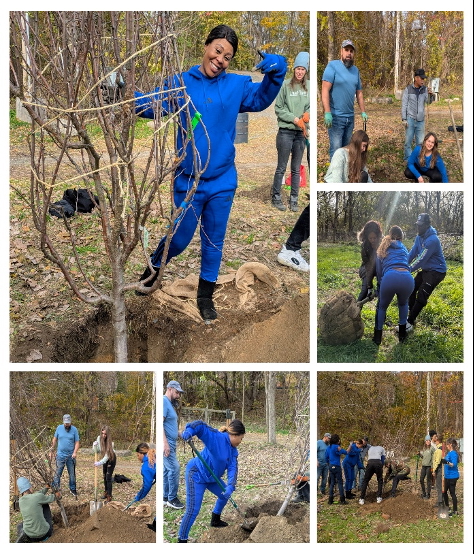
Motivated by this mission, we rolled up our sleeves and got to work. The scent of fresh earth mixed with our laughter and songs as we worked side by side. Our shoes grew dirty, but our determination only strengthened. Before planting, we measured the land and dug holes about two feet deep, spacing each one fifteen feet apart to give the young trees room to grow. Digging into the compacted soil was surprisingly difficult, and lifting the heavy trees into place challenged every one of us. Each shovel of soil reminded me that meaningful change often begins with humble, steady work. As we gently packed the soil around the roots, I imagined children picking fruit, breathing cleaner air, and enjoying cooler, greener neighborhoods. What started as a simple volunteer task became a lesson in environmental stewardship, community, and resilience.
This experience showed me how even small actions can spark significant environmental change. It reaffirmed my belief in the saying, “Where there is a will, there is always a way.” These trees will purify the air, sequester carbon, provide shade that reduces temperatures, and offer fresh fruit to the community for years to come. Our team didn’t just plant trees—we planted hope. These trees are more than leaves, roots, and branches; they are promises, living reminders of what we can accomplish together.