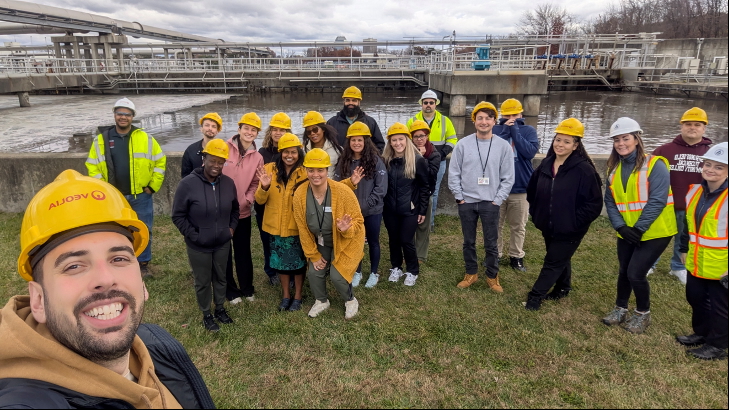
Submitted by Andres Davila, an STCC students and member of Phi Theta Kappa
My name is Andres Davila, and I am a Health Science student at Springfield Technical Community College (STCC). I am also a proud member of Phi Theta Kappa (PTK), the international honor society that recognizes academic excellence and provides opportunities for scholarship, leadership, and service.
Before attending STCC, I worked as an IT Technician. Over time, however, I realized I wanted to explore a career that combined technology with helping people. Helping patients with fractures, sprains, and broken bones has always been a goal of mine. Being a father and seeing my daughter have X-rays opened my eyes to how technology and patient care work together, which is why I am preparing to apply to the Radiologic Technology Program.
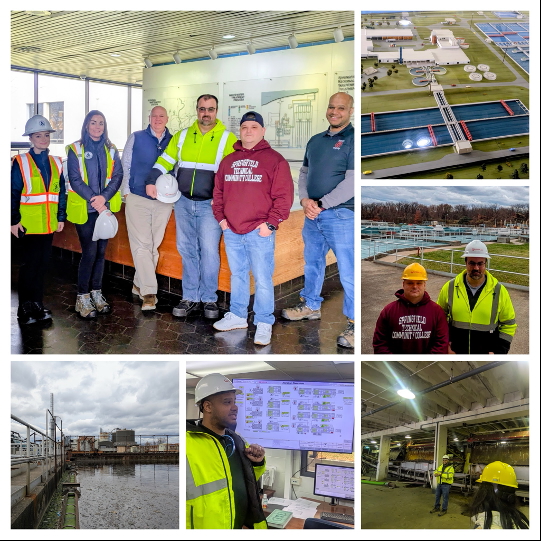
As part of our PTK project on Environmental Sustainability, we visited the Springfield Water and Sewer Commission (SWSC) to study its operations. We were warmly welcomed by their team, including Katherine Shea, their Educational Outreach Manager, and Kelly Olanyk, our guide and educator. Kelly provided an overview of the plant using a large model in the foyer. This facility can treat up to 67 million gallons of wastewater per day, serving approximately 44 million homes in Springfield. The impact of this wastewater treatment plant on the environment is significant: it protects natural water resources, reduces pollution, and improves public health.
We were given yellow hard hats for protection as the tour began. Walking through the massive facility and seeing the computer systems, headworks, machinery, and huge processing tanks up close was truly eye-opening. Bondi Island, where the plant is located, was named after Luigi Bondi, who came to Springfield with his wife and children in the late 1800s. He purchased the island on the Connecticut River in 1889 for just $100. The first wastewater treatment plant was built on Bondi Island in the late 1930s, with secondary treatment added in 1977.
The wastewater treatment process consists of two major steps: primary treatment and secondary treatment. During primary treatment, large screens capture solid waste. The odor at this stage is strong but normal; several students instinctively covered their noses, which brought a moment of laughter. Water then moves into primary clarifier tanks, where heavier solids sink to form sludge, and lighter materials, like oils and grease, float to the top. Skimmer blades remove debris and collect oils and grease, creating a swirling effect that looked a bit like lava.
During secondary treatment, water flows into aeration tanks, where air supports bacteria that break down organic matter. In secondary clarifiers, the bacteria settle at the bottom; some return to the aeration tanks to continue the process, while the excess sludge is sent to a separate company to be repurposed as fertilizer, fondly called “cake.” The treated water is then disinfected (chlorinated) and dechlorinated before being discharged into the Connecticut River. The murky water we saw at the start was transformed into crystal-clear water that sparkled like diamonds as it flowed into the river. I was genuinely amazed by the science and technology involved at every step.
In conclusion, witnessing the teamwork, dedication, and expertise of the SWSC staff inspired me to reflect on the impact I hope to make in healthcare. This experience motivates me to continue preparing diligently for the Radiologic Technology Program, combining my technical skills with patient care to make a meaningful difference in people’s lives. I am grateful to PTK at STCC and the team at Bondi Island for providing this invaluable learning experience.