(Submitted by Vincent Githiri)
When our names were announced as the second-prize winners of the 2026 Community College Innovation Challenge, the moment felt almost unreal. We had arrived in Washington, D.C., carrying a research poster, months of hard work, and a bold belief that community college students could help address a global environmental problem. We returned to STCC with a national award and a new understanding of what is possible when science, teamwork, and purpose come together.
My name is Vincent Githiri, and I am a Biology major at STCC with the goal of becoming a physician assistant and continuing my soccer career. I chose STCC because of its wide range of academic programs and the strong support it provides to students. Becoming a member of the Phi Theta Kappa Honor Society opened even more doors for me, including the opportunity to participate in the Community College Innovation Challenge, known as CCIC.
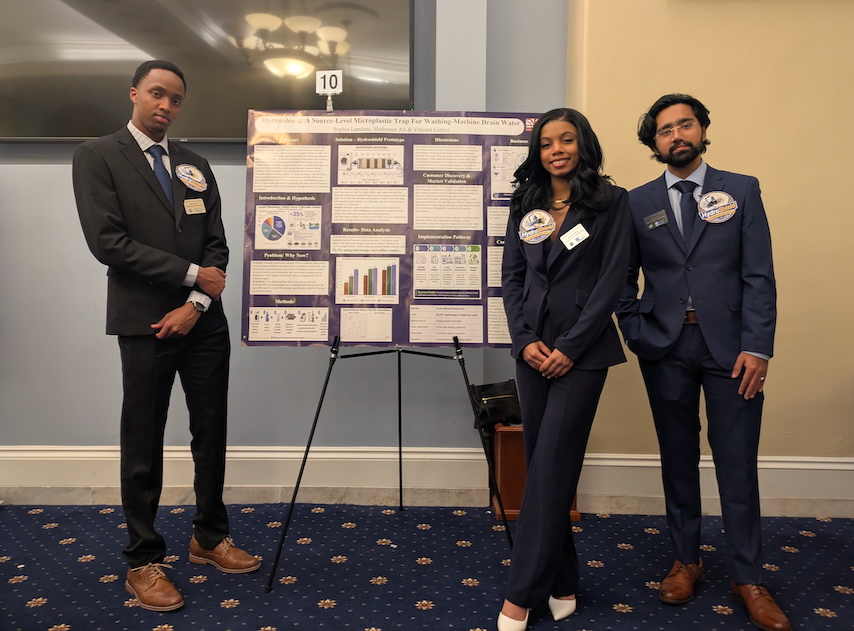
Our HydroShield team included fellow PTK students Sophia Landrau, Shahmeer Ali, and me, with Professor Reena Randhir serving as our faculty mentor. Throughout the journey, we were also fortunate to receive guidance from several STCC and UMass professors, Dr. Thuot and STEM Dean Dreger who generously shared their scientific, technical, and business expertise.
HydroShield began with a simple but urgent question: What if we could stop microfiber pollution before it ever reaches our waterways?
Every time synthetic clothing is washed, tiny plastic fibers can be released into the wastewater. I was shocked to learn that an estimated 35% of the microfibers entering our waterways originate from washing synthetic clothing. These fibers may pass through wastewater treatment systems and eventually enter rivers, oceans, soil, wildlife, and the food chain.
Our team developed HydroShield, a low-cost washing-machine drain filtration system designed to capture microfibers at their source. The prototype combines stainless-steel mesh, biochar, and chitosan. Biochar can be produced from agricultural waste, while chitosan is derived from discarded crustacean shells. By transforming waste materials into useful filtration layers, HydroShield also supports the principles of a circular economy, giving discarded resources a valuable second life.
The project reflects the One Health approach, which recognizes that the health of people is closely connected to the health of animals and the environment. Protecting water from microfiber pollution is therefore not only an environmental concern; it is also a matter of public health and community well-being.
The CCIC Boot Camp reshaped the way we understood innovation. We arrived focused mainly on the science and engineering behind our prototype. We soon discovered that even an excellent invention cannot create change unless people understand it, trust it, and see how it can improve their lives.
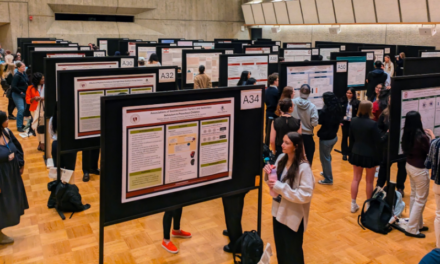
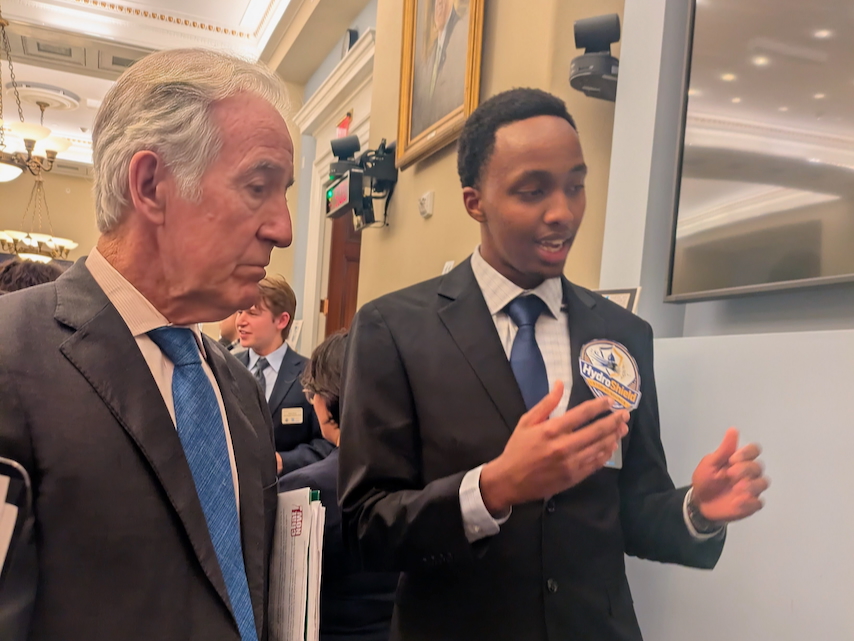
One of the most memorable experiences was presenting our HydroShield research poster at the Cannon House Office Building on Capitol Hill. Leaders from the National Science Foundation, the American Association of Community Colleges, congressional offices, and other national organizations attended the presentation. A particularly meaningful moment came when Congressman Richard Neal, who represents our Massachusetts district, stopped at our poster. We had the opportunity to explain HydroShield, share our research, and describe the environmental problem we hope to address. Congressman Neal listened to us, encouraged us, and showed genuine interest in our work.
For three community college students presenting research in the halls of Congress, his encouragement meant the world to us. It made us feel that our ideas mattered and that students like us could have a voice in national conversations about science, innovation, and environmental protection. That moment is something we will always remember.
Another highlight of the week was working with Joe Schreiber, a 13-time Emmy Award winner, who taught us the power of storytelling. He reminded us that facts can inform people, but stories inspire them to care and act. His guidance inspired me to create our memorable message: “Microplastics in the drain can contaminate your brain.” We also learned from Dr. Grant Warner, whose sessions introduced us to the entrepreneurial side of innovation and challenged us to think beyond the prototype.
At the end of the Boot Camp, we delivered a five-minute pitch before a national panel of judges, presenting the science, social impact, and future potential of HydroShield. Standing together on that stage and confidently defending our idea was one of the most challenging and rewarding moments of our journey.
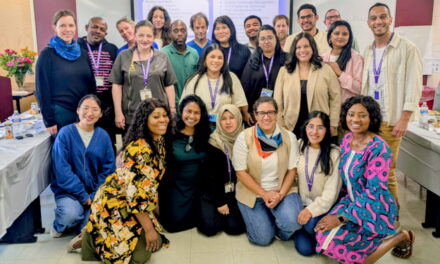
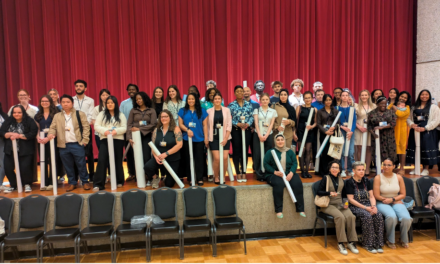
We also met brilliant students from community colleges across the country, each working on innovative solutions to real-world problems. Their creativity inspired us, and the friendships we formed were priceless. We went to Washington, D.C., with an idea. We returned with a national award, a stronger mission, and the confidence to believe that our work can make a meaningful difference in the world.